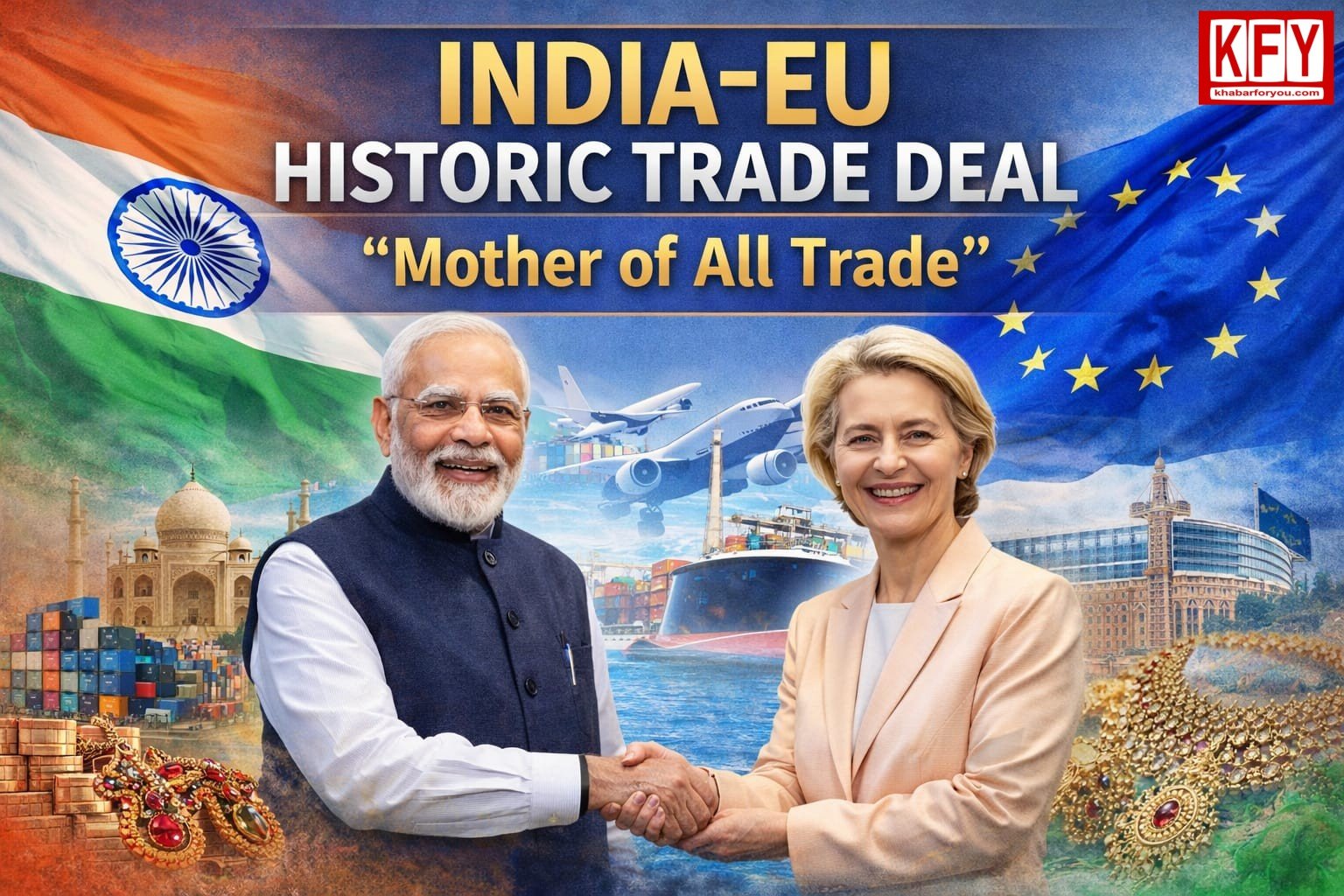
India-EU Trade Deal 2026: The "Mother of All Deals" Explained | Khabar For You
- DIVYA MOHAN MEHRA
- 28 Jan, 2026
- 97216

Email:-DMM@khabarforyou.com
Instagram:-@thedivyamehra


New Delhi / Brussels - In a landmark moment for global commerce, India and the European Union (EU) have concluded a comprehensive Free Trade Agreement (FTA) after nearly two decades of negotiations - a pact now hailed by leaders on both sides as the “mother of all trade deals.”
The agreement, expected to be formally signed in 2026 and implemented by early 2027 after legal clearances, aims to dramatically expand market access, slash tariffs on the vast majority of goods, and deepen economic cooperation between India and the EU’s 27 member states - together forming one of the largest trading partnerships in the world.
Read More - अजीत पवार विमान दुर्घटना समाचार: महाराष्ट्र के डिप्टी सीएम का बारामती में निधन | KhabarForYou
What Is This Trade Deal?
The India-EU Free Trade Agreement is a comprehensive bilateral FTA designed to:
- Eliminate or reduce tariffs on most goods traded between India and the EU.
- Enable freer movement of services, investment, and skilled professionals.
- Create a stable framework for trade rules, customs procedures, and regulatory cooperation.
- Deepen collaboration on sustainability, innovation, and high-technology sectors.
The European Commission president described the pact as a “mother of all deals,” reflecting its unprecedented scale and significance for both economies.
Together, India and the EU represent a combined market of nearly two billion people and account for about a quarter of global GDP and roughly one-third of world trade.
Historic Tariff Cuts & Market Access
One of the most transformative elements of the deal is tariff liberalization:
- EU imports to India: India will reduce or eliminate tariffs on about 96.6 % of EU goods by value, making machinery, chemicals, and industrial products far more competitive in the Indian market.
- Indian exports to EU: More than 99 % of Indian exports by value will receive preferential access to EU markets, opening the door for textiles, marine products, leather, and gems and jewellery to enter duty-free or with lowered duties.
- Specific sectors: Indian textiles, apparel, leather goods, and marine exports will benefit from immediate or phased tariff removals, and gems and jewellery trade is expected to double in value to around $10 billion within the next few years.
Consumer goods will also be affected: India will progressively slash tariffs on automobiles - currently up to 110 % - to single digits (around 10 %) under a quota system, and reduce duties on wines, spirits, and beer significantly.
Beyond Goods: Services, People & Technology
Unlike many trade pacts focused narrowly on goods, this agreement reaches into services, investment, intellectual property, and mobility:
- Services access: Indian firms will gain stable entry into EU services markets - including IT, professional services, finance, and maritime services - while EU service providers will enjoy reciprocal benefits in India.
- Mobility of talent: The deal introduces frameworks for easier movement of professionals, skilled workers, and business visitors, reflecting the importance of human capital in modern economies.
- Innovation cooperation: Measures on regulatory cooperation, digital trade, and intellectual property protections aim to facilitate investment and spur collaboration on technology and sustainability.
The pact also includes provisions to simplify customs procedures and non-tariff barriers, potentially accelerating the flow of goods and reducing trade costs for businesses on both sides.
Strategic & Global Benefits
Analysts say the India-EU deal is not only economically significant but strategically timely. With lingering global trade tensions and rising protectionism - especially in the United States and China - the pact offers both parties a way to diversify trade relations and strengthen supply-chain resilience.
India’s total trade with the EU stood at approximately $136.5 billion in 2024-25, narrowly outpacing India’s trade with the United States and China - highlighting how critical the EU market has become.
For India, the agreement supports key national initiatives such as “Make in India” and bolstering export-led growth. For the EU, a fast-growing Indian consumer market and access to competitive Indian services and manufacturing - especially in textiles, engineering, and digital sectors - are major gains.
Challenges & Safeguards
Despite broad tariff cuts, the FTA excludes certain sensitive agricultural products - like rice, dairy, and sugar - which remain protected to safeguard domestic farmers and markets on both sides.
Additionally, industry groups have raised questions about areas such as environmental regulations, carbon taxes, and the pace of tariff reductions - particularly in sectors where competitiveness concerns remain.
Looking Ahead
The treaty must still be ratified by EU member states, the European Parliament, and India’s cabinet before it takes effect. Official implementation is expected by early 2027, after legal vetting and regulatory approvals.
Once operational, the India-EU agreement could reshape global trade patterns, boost exports, create jobs, and strengthen economic links between two of the world’s most dynamic economic blocs. As leaders described it, this is not just a trade deal - it’s a strategic partnership for a new era of prosperity.
Business, Sports, Lifestyle ,Politics ,Entertainment ,Technology ,National ,World ,Travel ,Editorial and Article में सबसे बड़ी समाचार कहानियों के शीर्ष पर बने रहने के लिए, हमारे subscriber-to-our-newsletter khabarforyou.com पर बॉटम लाइन पर साइन अप करें। |
Business, Sports, Lifestyle ,Politics ,Entertainment ,Technology ,National ,World ,Travel ,Editorial and Article में सबसे बड़ी समाचार कहानियों के शीर्ष पर बने रहने के लिए, हमारे subscriber-to-our-newsletter khabarforyou.com पर बॉटम लाइन पर साइन अप करें। |
| यदि आपके या आपके किसी जानने वाले के पास प्रकाशित करने के लिए कोई समाचार है, तो इस हेल्पलाइन पर कॉल करें या व्हाट्सअप करें: 8502024040 |
#KFY #KFYNEWS #KHABARFORYOU #WORLDNEWS
नवीनतम PODCAST सुनें, केवल The FM Yours पर
Click for more trending Khabar
Leave a Reply
Your email address will not be published. Required fields are marked *
Search
Category